Zone d'identification
Cote
Bonomi MSS 32.5
Titre
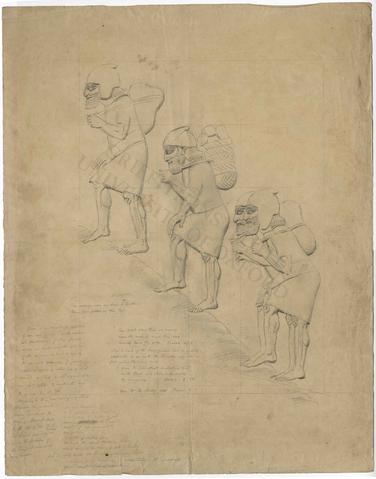
Iraq. Nineveh. South-West Palace of Sennacherib. Court VI (I). Panels 66-67. Relief depicting four male captives removing stones in baskets, c. 700-692 BC; sketch in grid from gypsum slab now in London, British Museum, BM 124821 = 1851,0902.5
Date(s)
Niveau de description
Pièce
Étendue matérielle et support
1 item
Zone du contexte
Nom du producteur
(1796-1878)
Histoire archivistique
Source immédiate d'acquisition ou de transfert
Zone du contenu et de la structure
Portée et contenu
Relief depicting four male captives removing stones in baskets, c. 700-692 BC; sketch in grid from gypsum slab (panels 66-67) from Court VI (I) in the South-West Palace of Sennacherib at Nineveh in Iraq, now in London, British Museum, BM 124821 = 1851,0902.5:
- pencil sketch on paper
- loose
- 44.5 x 56.7 cm
- [on sketch] 'The younger men are chained {two} together / Some have fetters on their legs' (pencil note)
- [on sketch] '"Thou didst show them no mercy / whom the ancient hast thou very / heavily laid thy yoke" Isaiah 47.6 / This is said of the Babylonians but is equally / applicable as we see to the Ninevites who were in / fact under the same rule / "Woe to him that buildeth a town / with blood (underlined) and stablisheth a city / by iniquity!" Habak 2 12 / Woe to the bloody city Nahum 3 1' (pencil note)
- [on sketch] 'This is a remarkable expression / of age and fatigue in the attitude / and countenance of their figures / which no doubt was the intention / of the assyrian artist to convey / It represents a number of jewish? / captives carrying stones up a steep / mound so steep as to require holes / or foot steps to enable the me / to go up to its top / It may be they are conveying stones / to make an inclined / plain over which to / drag a colossal bull / to the top of one of the / artificial mounds {or hills} on / which the palaces of / the kings of Nineveh / were built.' (pencil note)
- [on sketch] 'The word translated blood (underlined) / in the quotation from Habakak / is [...] in the plural / perhaps to signify (partially rubbed out) the {repeated} cruel / waste of life occasioned by / own fatigue / So in the quotation from / Nahum the word bloods is [...] / which might be rendered city of bloods / {that is} city built at the cost of so many lives / a succession of captives, of deportations of the inhabitants / from neighbouring countries' (pencil note)
Évaluation, élimination et calendrier de conservation
Accroissements
Mode de classement
Zone des conditions d'accès et d'utilisation
Conditions d'accès
Conditions de reproduction
Copyright Griffith Institute, University of Oxford