Identity area
Reference code
Title
Date(s)
- 1922-1933 (Creation)
Level of description
Extent and medium
Context area
Name of creator
Biographical history
British archaeologist and photographer. Born, Stamford 1879. Died, Asyut 1940. Began his photographic career in Florence with the art historian Henry Hobart Cust. He was then engaged as a excavator at Thebes by Theodore Davis between 1910-14. Then from 1914 onwards he worked for the rest of his career as a photographer for the Metropolitan Museum of Art, New York. His task was to record many of the royal and private tombs at Thebes. Between 1922 and 1933 he was lent by the Metropolitan Museum to Lord Carnarvon and Howard Carter to make a photographic record during the excavation of the tomb of Tutankhamun.
Archival history
Part of Howard Carter's estate. Bequeathed to Carter's niece Miss Phyllis Walker in 1939.
Immediate source of acquisition or transfer
The negatives were presented to the Griffith Institute by Miss Phyllis Walker in 1946. Miss Walker transferred the copyright for the negatives to the Griffith Institute.
The negatives were stored at the Mincing Lane Safe Deposit Co. Ltd, Mincing Lane, London, during World War II. The negatives were transported directly to the Griffith Institute from Mining Lane in early May 1946.
Content and structure area
Scope and content
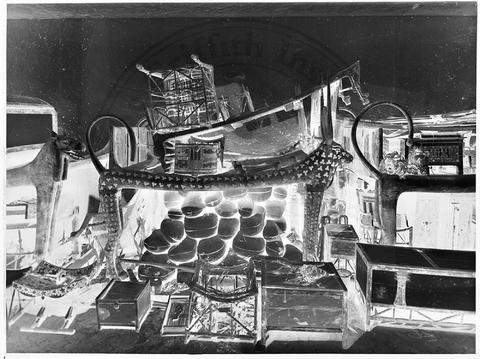
Harry Burton's large glass plate negatives.
- Taken by Harry Burton during the excavation, clearance and recording of Tutankhamun's tomb
- Approximately 860 negatives
- Number ranges 1-2024 and i-xcvii
- The negative number ranges comprise both the small and large negatives (small, see TAA i.6)
Appraisal, destruction and scheduling
Accruals
System of arrangement
Conditions of access and use area
Conditions governing access
Property of the Griffith Institute. No restrictions.
Conditions governing reproduction
Copyright Griffith Institute, University of Oxford.
Language of material
Script of material
Language and script notes
Physical characteristics and technical requirements
- Most of the negatives are approximately 17.9 x 23.9 cm
Finding aids
Allied materials area
Existence and location of originals
Existence and location of copies
Archived scans in Griffith Institute.
Related units of description
Publication note
- http://www.griffith.ox.ac.uk/gri/carter/gallery/ etc.
- http://www.griffith.ox.ac.uk/gri/4tutgal1.html
- http://www.griffith.ox.ac.uk/gri/4tutgal2.html
- http://www.griffith.ox.ac.uk/gri/4tutgal3.html
- The photographs are also featured alongside the Tutankhamun object cards, see http://www.griffith.ox.ac.uk/gri/carter/ etc.
Publication note
- Reproduced in numerous publications including:
- Carter, Howard 1923-1933. The tomb of Tut.ankh.Amen: discovered by the late Earl of Carnarvon and Howard Carter, 3 vols. Photographs by Harry Burton (OEB 136412).
- The Times (London), particularly 1922-1933
- The Illustrated London News, particularly 1922-1933
- Fox, Penelope 1951. Tutankhamun's treasure (OEB 2854)
- Desroches Noblecourt, Christiane 1963. Toutankhamon: vie et mort d'un pharaon (OEB 215695)
- Desroches-Noblecourt, Christiane 1963. Tutankhamen: life and death of a pharaoh (OEB 9997)
- Reeves, Nicholas 1990. The complete Tutankhamun: the king - the tomb - the royal treasure (OEB 32978)
- Griffith Institute 2022. Tutankhamun: excavating the archive (OEB 298597)
Publication note
- Comprehensive study of Harry Burton's photography for the Tutankhamun excavation, see Riggs, Christina 2019. Photographing Tutankhamun: archaeology, ancient Egypt, and the archive (OEB 263370).
Notes area
Note
- A set of film negatives was made in 1980, see TAA iii.4.
- The film negatives were intended to be used as a 'working set' to reduce the handling of the original Burton negatives.
- However, prints made from the film negatives were inferior to those made from the original negatives.
- New contact prints continued to be made from the original negatives until the late 1990s when demand changed from photographic prints to digital images.