- Complete set of three volumes of Howard Carter's popular account of the discovery and excavation of Tutankhamun's tomb, all first editions, no dust jackets:
- Carter, Howard and Mace, A. C. 1923. The Tomb of Tut.ankh.Amen Volume 1 [discovery, Antechamber and opening of the Burial chamber]
- Carter, Howard 1927. The Tomb of Tut.ankh.Amen Volume 2 [Burial chamber, opening the sarcophagus, the state chariots, opening of the three coffins and examination of Tutankhamun's body and wrappings]
- Carter, Howard 1933. The Tomb of Tut.ankh.Amen Volume 3 [Treasury and Annexe]
- Letters and documents relating to Howard Carter's dispute with the Egyptian Government after the European team members' wives were barred from entering the tomb to view the contents of Tutankhamun's sarcophagus after the lid had been lifted (12 February 1924).
- The dispute on the following day, 13 February 1924, eventually resulted in Howard Carter and the rest of the team being locked out of the tomb until 13 January 1925.
- Includes correspondence between Sir Alan Gardiner and the Foreign Office, Egyptologists and others in 1924.
- Referred to as the "Carter Affair" or "Tutankhamun Affair".
- P. E. Newberry's copy of The Tomb of Tut-ankh-amen: Statement with documents, as to the events which occurred in Egypt in the Winter of 1923-24 leading to the ultimate break with the Egyptian Government.
- "Published for private circulation only by Cassell and Company, London, etc. 1924."
- Incorporates Howard Carter's original documentation, see TAA ii.21.
Restricted access file.
- Set of contact prints made from The Times Tutankhamun photographs.
- Most of the photographs were taken by The Times photographer.
- There are also a significant number of copies of Harry Burton's photographs within this group.
- Many of the contact prints are made from 35mm film, as well as a variety of larger prints.
A set of lithographs made for the Tutankhamun exhibition held in the British Museum, London, in 1972.
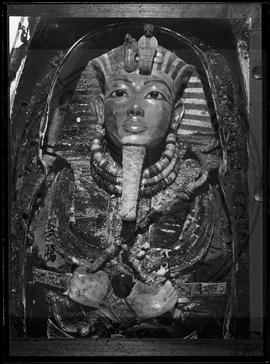
Colour photograph of Tutankhamun's mask, taken by Miss J. E. Shepherd in the Egyptian Museum, Cairo, in 1990.
- Digital image.
- Original negative made from a Lehnert & Landrock postcard, Cairo, probably late 1920s or 1930s.
- Postcard caption: 013 TUTANKHAMEN SERIES GOLD PORTRAIT MASK OF KING
- Original postcard features an edited version of Burton photograph P0757.
- Mask of Tutankhamun (256a), gold inlaid with coloured glass and semi-precious stones, in Cairo, Egyptian Museum, JE 60672.
- Digital image.
- The original negative was made from a Lehnert & Landrock postcard, Cairo, probably late 1920s or 1930s.
- Postcard caption: 018 TUTANKHAMEN SERIES THE TUTELARY GODDESS SELKIT
- Original postcard features Burton photograph P1550.
- Statue of the goddess Selkis from Tutankhamun's canopic shrine (266), gilded wood, in Cairo, Egyptian Museum, JE 60686.
- Digital image.
- Original negative made from a Lehnert & Landrock postcard, Cairo, probably late 1920s or 1930s.
- Original postcard features Burton photograph KV79.
- Postcard caption: 003 TUTANKHAMEN SERIES ENTRANCE TO TOMB
- View of the modern enclosure wall protecting the entrance to the tomb of Tutankhamun.
- Fourteen postcards, many feature Harry Burton's photographs taken during the excavation of the tomb of Tutankhamun.
- Some were produced by Lehnert & Landrock.
- Others produced by Bruce Co., London.
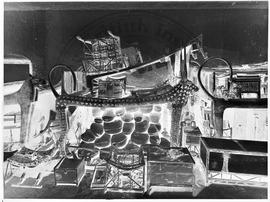
- Showing various objects from the tomb of Tutankhamun.
- Photograph showing Howard Carter (left) and an Egyptian team member carrying one side of the hippopotamus couch (137) out of the tomb of Tutankhamun.
- Negative made from an original photograph.
- Original photograph, photographer not known. Taken in early 1923.
- Labelled: ‘At the Luxor Tomb. At the Exit from the tomb. Mr. H. Carter helping to carry out a section of one of the couches’.
- Professor H. Beinlich's photographs and his transcription of its texts
- Innermost coffin (255) of Tutankhamun, gold, in Cairo, Egyptian Museum, JE 60671.
- TAA ii.14.1-56 (photos), 57 (transcriptions).
- Photographs and colour transparencies of a scale model of the tomb of Tutankhamun, created for a display in Highclere Castle in 1988.
- Model created by Orchard Brothers, Historical model makers.
- Copies of notes and photographs for boxes from Tutankhamun's tomb.
- The measurements of the boxes, etc., were copied from the original Tutankhamun Archive documentation by A. H. Gardiner for Myrtle Broome.
Rainbow McLean's photographs of box (21), from the tomb of Tutankhamun, now in Cairo, Egyptian Museum, JE 61467.
Sans titre- Photographs of six cubit rods from the tomb of Tutankhamun.
- All rods are made of wood.
- Carter object numbers:
- (50dd'), now in Cairo, Egyptian Museum, JE 61315.
- (50dd''), now in Cairo, Egyptian Museum, JE 61316.
- (50ee'), now in Cairo, Egyptian Museum, JE 61317.
- (50ee''), now in Cairo, Egyptian Museum, JE 61318.
- (50ff'), now in Cairo, Egyptian Museum, JE 61319.
- (50ff''), now in Cairo, Egyptian Museum, JE 61320.
Penelope Fox's notes on furniture from the tomb of Tutankhamun. Perhaps for a planned publication.
Sans titreMaterial other than excavation records.
Tutankhamun Excavation. Howard Carter's notes on various subjects.
- i. General note on tomb robbery.
- ii. Jewellery. References to pectoral (261P(2)), docket from box (267), etc.
- iii. Three pages of manuscript notes on 'The last and final season's work in the Tomb of Tutankhamun', including references to the sarcophagus, shrines, etc.
- iv. A note on the contents of rooms and disturbance by ancient robbers.
- v. Two handwritten notes concerning tomb plan development in the New Kingdom.
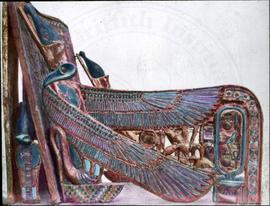
Howard Carter's lantern slides featuring Harry Burton's photographs taken during the excavation of Tutankhamun's tomb.
- A twelve-drawered wood chest containing 632 glass lantern slides
- Belonging to Howard Carter.
- The lantern slides were made from Harry Burton's images.
- Used by Carter in his lectures.
Tutankhamun excavation - Harry Burton's original contact prints made from the original glass plate negatives
- Set of original photographic prints.
- Most were created by Harry Burton.
- Some prints were made in the Ashmolean Museum Photographic Studio between the mid-1940s and the 1970s.
Ten albums containing original photographic prints made by Harry Burton [TAA i.6.1-10].
- Arranged by chamber and by object type
- Annotated headings and negative numbers, probably by Harry Burton or his wife Minnie B.
- Howard Carter's set of albums
Originally belonging to Howard Carter.
Sans titreHarry Burton's small glass plate negatives
Howard Carter's negatives
Later film negatives, made from original Burton photographs
- Some are original Harry Burton negatives.
- Carter's negatives are views of the area around the tomb entrance and the outer sealed doorway when the tomb was found in 1922 and before Burton joined the Tutankhamun excavation team in December 1922.
- Glass and film negatives.
- Approximately 1000 negatives (400 glass and 600 film)
- Number ranges 1-2024 and i-xcvii
- The negative number ranges comprise both the small and large negatives (large, see TAA i.5)
- A few original negatives in this series were created by Howard Carter, see above.
- Many of the negatives were made later in the Ashmolean Museum photographic studio from photographs supplied by the Metropolitan Museum of Art, New York, following an exchange of images in the 1950s.
- Includes modern film negatives made in the Ashmolean Museum photographic studio from the original Harry Burton photographic prints in the Tutankhamun Archive, Griffith Institute.
Harry Burton's large glass plate negatives.
- Taken by Harry Burton during the excavation, clearance and recording of Tutankhamun's tomb
- Approximately 860 negatives
- Number ranges 1-2024 and i-xcvii
- The negative number ranges comprise both the small and large negatives (small, see TAA i.6)
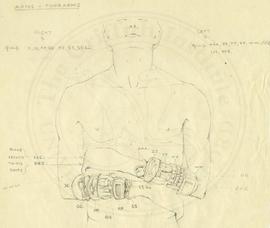
Howard Carter's "autopsy" drawings, recording objects in situ on Tutankhamun's body and within the body wrappings.
- 18 annotated pencil drawings of groups of objects found in the body wrappings and on the body of Tutankhamun, recorded during the autopsy of the King's body, 11-19 November 1925
- All by Howard Carter
Chemistry. Howard Carter's collected notes for the intended scientific publication of Tutankhamun's tomb.
- H. J. Plenderleith's typescript report on:
- i. The pigments contained in the palettes from the toy chest found in the Annexe;
- ii. The paint used on the Burial chamber walls;
- iii. The metal tongues from the second shrine;
- iv. The thickness of gold on shrines (also see Gesso notes);
- v. On animal skin found with gesso. Plenderleith suggests this is to provide a resilient cushion beneath gold for tooling;
- Typescript for a lecture given in 1926 by H. Bunker on 'Scientific Aspects of Tomb'.
Chariots. Howard Carter's collected notes for the intended scientific publication of Tutankhamun's tomb.
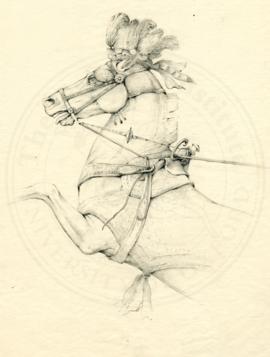
- Includes Carter's drawings with reconstructions of the chariots and harnesses, comparisons with chariots from other tombs and depictions of chariots from temple and tomb wall scenes.
- An essay on Tutankhamun's chariots (TAA i.3.8.10-17), based on Howard Carter's notes, probably edited by Mrs Jane Waley in 1946-1947. Mrs Waley worked for the Griffith Institute and created the first catalogue for the Tutankhamun records.
Chair (351). Howard Carter's collected notes for intended scientific publication of Tutankhamun's tomb.
- Carter's typescript description of chair (351).
- 3 pages.
- Carbon copies of originals filed with object cards for (351), annotated by Carter.
Tutankhamun documentation: Nina de Garis Davies' notes on boxes (21) and (540)+(551).
- Nina de Garis Davies's manuscript notes on the decoration of two boxes:
- Carter object (21), the "Painted Box" with battle and hunting scenes.
- Carter objects (540)+(551), with scenes of Tutankhamun and Ankhesenamun in a garden on the lid.
- Includes two small watercolour sketches and a line drawing, all created by Davies.
- This material was created in January and February 1951 when Davies visited the Egyptian Museum in Cairo.
- Davies's paintings of box (21) were subsequently published. See below for details.