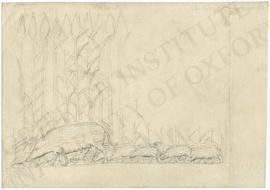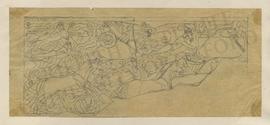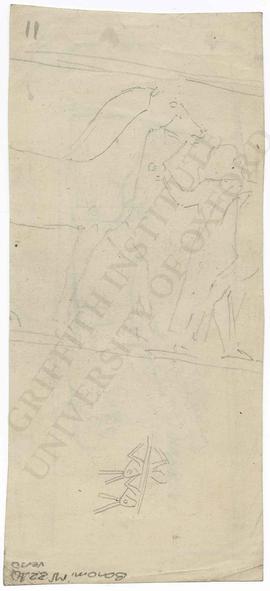
Detail of locusts in Bonomi MSS 32.10 (recto) and relief depicting horses being led by grooms, c. 700-692 BC; sketch from gypsum slab (panels 37-38) from Room LI (North) in the South-West Palace of Sennacherib at Nineveh in Iraq, now in London, British Museum, BM 124795,a-c = 1851,0902.14:
-pencil sketches on paper
-loose
-7.7 x 17.5 cm
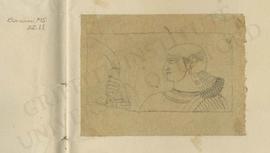
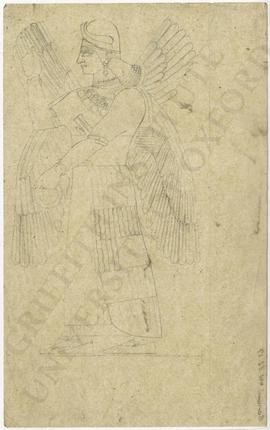
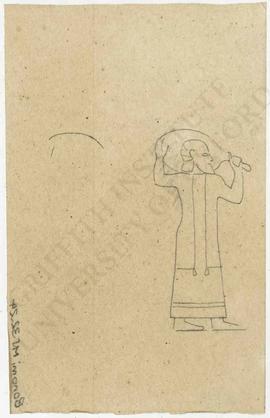
Relief depicting an eunuch attendant (head and shoulders) with fly-flapper facing left, c. 865-860 BC; sketch/tracing from gypsum slab fragment from Room G in the North-West Palace at Nimrud (Kahlu) in Iraq, currently in an unknown location:
- pencil sketch/tracing on paper
- mounted
- 12.2 x 9.1 cm
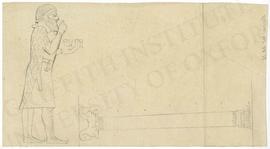
Relief depicting a man bringing a city model as tribute, c. 710-705 BC; sketch from gypsum slab (panels 6-7) from Room 10 in the Palace of Sargon II at Khorsabad in Iraq, now in Paris, Musée du Louvre, AO 19887; and sketch of column from Persepolis in Iran:
- pencil sketches on tracing paper
- loose
- 21 x 11.5 cm
Text (22 lines) in cuneiform script with annotations, now in the British Museum (not identified):
- print with pencil and brown pencil annotations on paper
- loose
- 10.7 x 18.9 cm
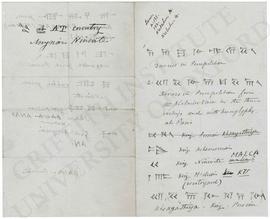
Names of kings, gods and places in cuneiform with their English equivalents:
- ink text on paper
- loose
- 25 x 20.2 cm
- [text]:
'at (underlined) AT country / Assyrian Ninevite /
Lane / n.133. / 126. / Niebuhr A. / Niebuhr G. /
1 / Darius in Persepolitan /
- / Heroes in Persepolitan from / the Alabaster Vase in the three / writings and with hieroglyphs / at Paris /
King Persian khsayathiya (underlined) /
King Achemenian /
King Ninevite ~malca?~ (underlined) MALCA /
King Median ~ku~ (underlined) KU (underlined) / (Westergard) /
Khsayathiya. King. Persian'
Names of kings, gods and places in cuneiform with their English equivalents:
- ink text on paper
- loose
- 25 x 20.2 cm
- [text]:
'great /RasararRASARAR (Median) / (Westegard) /
waz arka great Persian /
rabhu (underlined) great / Ninevite /
God Median / [?]BAGA. ANAP / Westegard /
God Assyrian / AN. /
BAGA in Persian.'
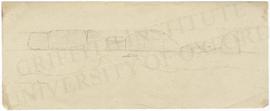
View of the west wall of Medinet Nimrood (Nimrud) in Iraq:
- pencil sketch on paper
- loose
- 24.2 x 9.8 cm
- [on sketch] 'MEDINET NIMROOD' (pencil note)
- [on sketch] 'The west wall of Timei[?]' (pencil note)
Relief depicting two ships rowing away from palace surrounded by sea creatures, c. 730 BC; drawing after Henry Layard's drawing of gypsum wall panel from the Central Palace of Tiglath-Pileser III at Nimrud (Kahlu) in Iraq, now partially in London, British Museum, BM 102981 = 1908,1010.1:
- Pencil drawing on paper
- loose
- 42 x 28.5 cm
- [on drawing] 'A.H. Layard.' (pencil note)
- [on drawing] 'Ceptre.' (pencil note)
Relief depicting a female winged protective spirit facing left, wearing a two-horned hat and holding a chaplet, performing an act of worship (?), c. 865-860 BC; sketch from gypsum slab (panel 20) from Room I in the North-West Palace at Nimrud (Kahlu) in Iraq, now in London, British Museum, BM 124578 = 1849,0502.4:
- Pencil sketch/tracing on tracing paper
- loose
- 15.3 x 24.8 cm
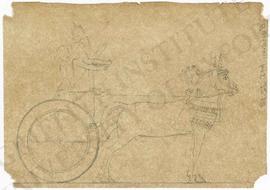
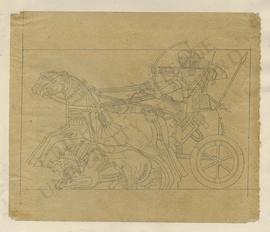
Relief depicting soldiers in a chariot, c. 640-620 BC; sketch/tracing from gypsum slab (panels 10-12) from Court XIX (U) in the South-West Palace of Sennacherib at Nineveh in Iraq, now in London, British Museum, BM 124825,b = 1851,0902.1.b:
- pencil sketch/tracing on tracing paper
- loose
- 11.4 x 8 cm
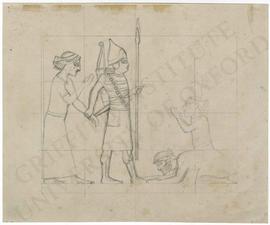
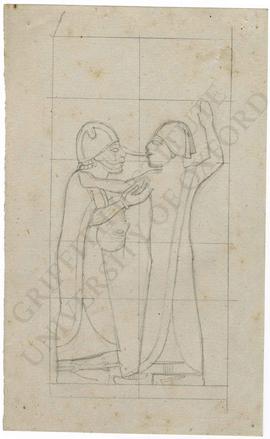
Iraq. Nineveh. South-West Palace of Sennacherib. Room XXXIII. Panels 4-6. Relief depicting an Assyrian eunuch general with three Elamite captives, c. 660-650 BC; unfinished sketch in grid from gypsum slab now in London, British Museum, BM 124802.a = 1851,0902.7.a:
- pencil sketch in grid on paper, with pricked marks for pouncing technique
- loose
- 21.6 x 17.8 cm
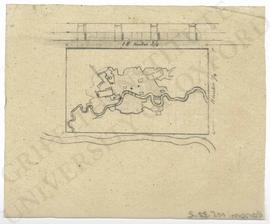
Schematic plan of London in the United Kingdom; preparatory sketch for publication:
- pencil sketch on tracing paper
- loose
- 9.9 x 8 cm
- [on drawing] '18 miles 3/4 / 11 miles 1/4' (pencil notes)
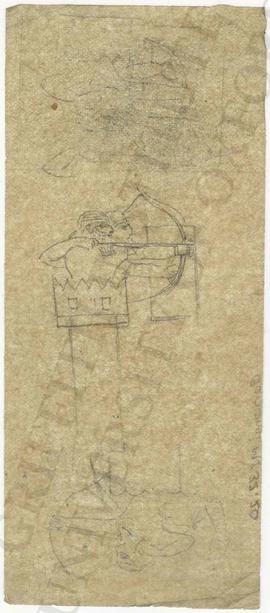
Relief depicting archers shooting from tower, Neo-Assyrian; three sketches from gypsum slab (not identified). Similar to relief depicting Ashurnasirpal II besieging a strongly-walled town which is being defended by archers, c. 865-860 BC; gypsum slab (panel 18 <top>) from Room B in the North-West Palace at Nimrud (Kahlu) in Iraq, now in London, British Museum, BM 124536 = 1847,0623.6:
- pencil sketches on tracing paper
- loose
- 5.8 x 13.3 cm
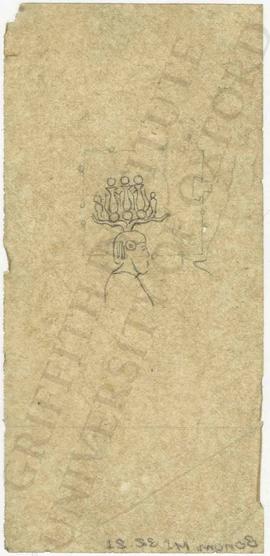
Sketch of a male figure wearing triple atef or hemhem crown:
- pencil sketch on tracing paper
- loose
- 5.7 x 12 cm
Sketch of two of the rock-stelae, with inscriptions and notes, at Nahr el-Kelb in Lebanon (TopBib vii.385):
- pencil sketch with brown wash on tracing paper
- loose
- 13.4 x 8.5 cm
- [on sketch] 'Band VII / abth 3 / blatt CLXXIII / CCXIII / 197 / abth III BL197' (pencil note)
Sketch of two of the rock-stelae at Nahr el-Kelb in Lebanon (TopBib vii.385):
- pencil sketch on tracing paper
- loose
- 7.4 x 9 cm
Relief depicting two men holding sacks, c. 710-705 BC; incomplete sketch/tracing from gypsum slab from the North-West Wall of Court VIII in the Palace of Sargon II at Khorsabad in Iraq, current location not known:
- pencil sketch/tracing on tracing paper
- loose
- 7.2 x 11.5 cm
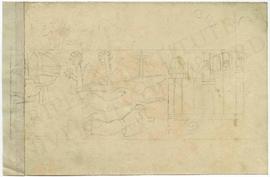
Relief depicting two Assyrian archers shooting three enemies in the water, c. 875-860 BC; sketch from gypsum slab (panel 17 <top>) from Room B in the North-West Palace at Nimrud (Kahlu) in Iraq, now in London, British Museum BM 124538 = 1849,1222.10:
- pencil sketch on paper (with strip of different paper fixed with glue to left side)
- loose
- 28 x 18.2 cm
Relief depicting two ships rowing away from palace surrounded by sea creatures, c. 730 BC; tracing after Henry Layard's drawing of gypsum wall panel from the Central Palace of Tiglath-Pileser III at Nimrud (Kahlu) in Iraq, now partially in London, British Museum, BM 102981 = 1908,1010.1:
- pencil tracing on tracing paper
- loose
- 25.1 x 19 cm
Relief depicting an eunuch attendant (head and shoulders) with fly-flapper facing left, c. 865-860 BC; sketch from gypsum slab fragment from Room G in the North-West Palace at Nimrud (Kahlu) in Iraq, currently in an unknown location:
- pencil sketch on paper
- loose
- 23.3 x 14.5 cm
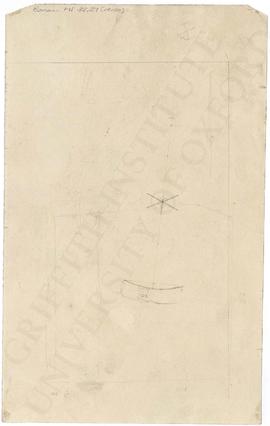
Rim of fragment of basalt clepsydra of Philip Arrhidaeus, from Tell el-Yahudiya, now in London, British Museum, inv. EA 938, c. 320 BC (TopBib iv.58A):
- pencil sketch on paper, with pricked marks for pouncing technique
- loose
- 14.5 x 23.3 cm
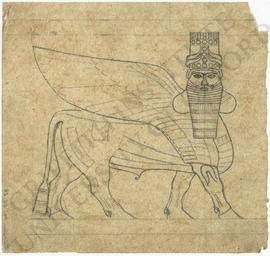
Sculpture depicting winged bull with human head (lamassu), c. 710-705 BC; tracing from gypsum sculpture in one of the gates of the Palace of Sargon II at Khorsabad in Iraq:
- pencil tracing on paper
- loose
- 15.7 x 14.8 cm
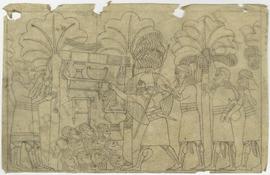
Relief depicting Assyrians carrying off booty and heads and booty piled up in a palm grove, c. 640-620 BC; drawing/tracing from gypsum slab (panels 10-12) from Court XIX (U) in the South-West Palace of Sennacherib at Nineveh in Iraq, now in London, British Museum, BM 124825,b = 1851,0902.1.b:
- pencil drawing/tracing on tracing paper
- loose
- 25.1 x 15.8 cm
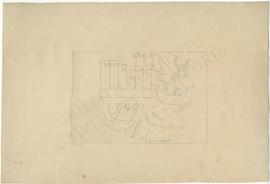
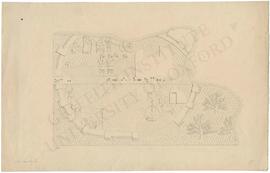
Relief depicting an Assyrian fortified camp, c. 660-650 BC; sketch from gypsum slab (no. 43) from Room V in the South-West Palace of Sennacherib at Niniveh in Iraq, left in situ, but reported stolen in 1995:
- pencil drawing on paper
- loose
- 37.1 x 23.6 cm
- [on sketch] 'Nº 39 Chamber C' (pencil note)
- [on sketch] 'Abth' (pencil note)
Relief depicting a wild sow with her young hidden in the reed thicket behind, c. 700-692 BC; sketch from gypsum slab from Court VI (I) in the South-West Palace of Sennacherib at Nineveh in Iraq, now in London, British Museum, BM 124824 = 1851,0902.2:
- pencil sketch on paper
- loose
- 16 x 11.2 cm
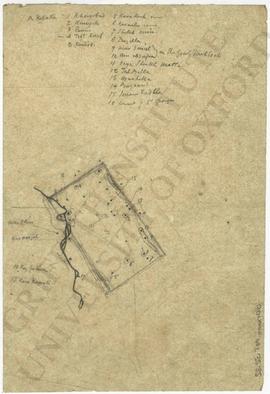
Map of the presumed boundary of ancient Nineveh:
- pencil sketch/tracing with notes on tracing paper
- loose
- 12.5 x 18.2 cm
- [on sketch]
'A Kelata
1 Khorsabad
2 Kounyik
3 E[?]
4 Tell Kaif
B Reshidi5 Kara Kush ruins
6 Karamles ruins
7 Sheikh emir
8 Tergilla
9 Mar Daniel
10 Ain es Sufra } on the Gebel Makloub
11 Deyr Sheikh Matti
12 Tel Billa
13 Bashika
14 Bazaani
15 Imam Fadhla
16 Convent of St GeorgeMar Elias
Yarumjeh
18 Kiz fukura
17 Kara Koyurabi[?]' (pencil note)
Relief depicting one man striking another man holding decapitated head, Neo-Assyrian; sketch in grid from gypsum slab (not identified), probably from the South-West Palace of Sennacherib at Nineveh in Iraq:
- pencil sketch on paper
- loose
- 10.9 x 17.8 cm
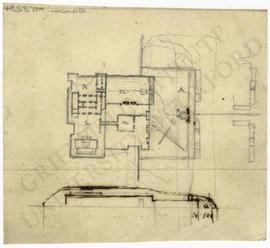
Plan of the platform in which the Palace of Sargon II at Khorsabad in Iraq stood:
- pencil and ink sketch/tracing on tracing paper
- loose
- 11 x 10 cm
Relief depicting Ashurnasirpal II and his army crossing the Euphrates, c. 865-860 BC; sketch from gypsum slab (panel 10) from Room B in the North-West Palace at Nimrud (Kahlu) in Iraq, now in London, British Museum, BM 124543 = 1848,1104.8:
- pencil sketch/tracing on tracing paper
- mounted, together with Bonomi MSS 32.36
- 25.2 x 11 cm
Relief depicting Ashurnasirpal II or his son and heir, Shalmaneser III, in his chariot on a lion hunt, c. 875-860 BC; drawing/tracing from gypsum slab from possibly Room WM on the West Wing in the North-West Palace at Nimrud (Kahlu) in Iraq, now in London, British Museum, BM 124579 = 1849,1222.8 (reversed):
- pencil drawing/tracing on tracing paper
- mounted, together with Bonomi MSS 32.35
- 25.5 x 21.3 cm