Area dell'identificazione
Codice di riferimento
Titolo
Date
- 1881-1882 (Creazione)
Livello di descrizione
Consistenza e supporto
Quarter of a page.
Area del contesto
Nome del soggetto produttore
Storia archivistica
Modalità di acquisizione
Area del contenuto e della struttura
Ambito e contenuto
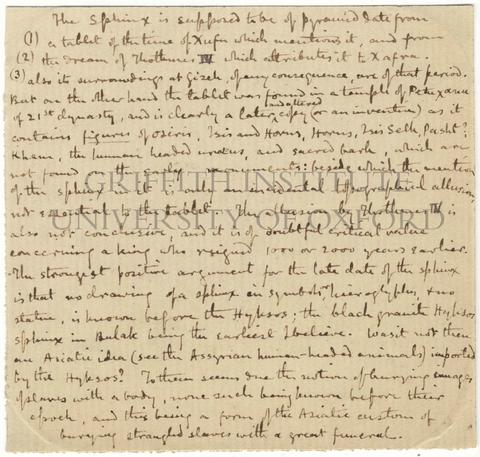
Giza (Gîza). The Great Sphinx.
Note reads:
'The Sphinx is supposed to be of pyramid date from (1) a tablet of the time of Xufu which mentions it, and from (2) the dream of Thothmes IV which attributes it to Xafra. (3) also its surroundings at Gizeh, of any consequence, are of that period. But on the other hand the tablet was found in a temple of Petuxanu of 21st dynasty, and is clearly a later and altered copy (or an invention) as it contains figures of Osiris, Isis and Horus, Horus, Isis Seth, Pasht?, Khem, the human headed uraeus, and sacred bark, which are not found on the early monuments: beside which the mention of the sphinx in it is only an incidental topographical allusion, not essential to the tablet. The allusion by Thothmes IV is also not conclusive, and it is of doubtful critical value concerning a king who reigned 1000 or 2000 years earlier. The strongest positive argument for the late date of the sphinx is that no drawing of a sphinx in symbols, or hieroglyphs, & no statue, is known before the Hyksos; the black granite Hyksos sphinx in Bulak being the earliest I believe. Was it not then an Asiatic idea (see the Assyrian human-headed animals) imported by the Hyksos? To them seems due the notion of burying images of slaves with a body, none such being known before their epoch, and this being a form of the Asiatic custom of burying strangled slaves with a great funeral.'
Valutazione e scarto
Incrementi
Sistema di ordinamento
Area delle condizioni di accesso e uso
Condizioni di accesso
Condizioni di riproduzione
Copyright Griffith Institute, University of Oxford