حقل المعرف الفريد
الرمز المرجعي
العنوان
التاريخ (التواريخ)
- 1843-1848 (Creation)
مستوى الوصف
مدى ونوع المادة الموصوفة
1 lithograph
حقل السياق
مسمى المنشئ
السيرة الذاتية
French Egyptologist; he was born in Avesnes-sur-Helpe 27 Jan 1807, son of Constant P., an inspector of the woods belonging to the Prince of Talleyrand who died of typhus in 1814, and Claire Constance Theresa Victoire Pinot; he was brought up by a local cure after the death of his father, and was educated at Chalons-sur-Marne 1822-5, where he obtained the diploma of Engineer-Architect; he took part in the Greek War of Independence, 1826, and then went to Egypt in 1827 where he obtained an appointment as engineer and lecturer in military schools under Muhammad Ali which lasted until 1836; from 1836-1844 he undertook the copying of Egyptian monuments; in 1842 he founded with Henry Abbott the Association Litteraire in Cairo; he cut out the Table of Kings at Karnak in 1843 and overcoming great difficulties removed it to France; he revisited Egypt in 1858-60 with Testas; his name is particularly associated with the famous papyrus in the Bibl. Nationale (Cartons 183-94) and with the Table of Kings; Prisse was an outstandingly brilliant observer and was one of the first to note the Aten blocks in the Horemheb pylons at Karnak, 1839, and wrote to Wilkinson about them at a time when they were scarcely understood; he copied much that has since gone, when rooms were being cleared in temples or walls destroyed for masonry; he adopted the name Idris-Effendi and although known to many visitors to Egypt, received little recognition in his lifetime except for the award of the rank of Chevalier of the Legion d'honneur. The splendid series of publications, included, besides the facsimile of his papyrus discovered in 1843, Les Monuments egyptiens, fol. 1847, to complement Champollion's work; Oriental Album. Characters, costumes and modes of life in the Valley of the Nile illustrated from designs taken on the spot by E. Prisse, with descriptive letter-press by James Augustus St. John, 1848-51; Atlas de l'histoire de l'art egyptien, d'apris les monuments, depuis les temps les plus reculesjusqu'a la domination romaine, atlas in 2 vols. fol. 1858-77, reprint, 1991; L'Art arabe, d'apres les monuments du Caire, depuis le Me siecle jusqu'a la fin du XVIIIe siecle, 3 vols. fol. 1867-79. He died in Paris, 10 Jan. 1879.
التاريخ الأرشيفي
المصدر المباشر للاقتناء أو النقل
حقل المحتوى والبنية
النطاق والمحتوى
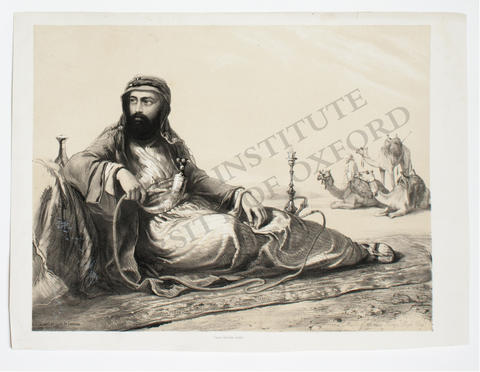
Memorial portrait of George Lloyd. Lloyd is portrayed reclining on a rug, wearing Arab clothing and holding the mouth-piece of a hookah-pipe in his right hand. The scene is set in a desert campsite, perhaps fictional, in Egypt, with a man standing with three camels in the background. The drawing this lithograph was based on was created by É. Prisse d'Avennes sometime between 1843 and 1848:
- three colour tinted lithograph
- loose item, perhaps not originally with the album but placed with it later
- 41.5 x 30.5 cm (print area of 36.1 x 27.7 cm)
- [on recto of lithograph] 'Drawn on stone by Lemoine. [caption]
- [on recto of lithograph] 'Portrait of the late George Lloyd Esqr' [caption]
- [on recto of lithograph] 'James Madden_London' [caption]
- [on verso of lithograph] '330' and enclosed ',1039' (pencil notes)
التقييم، الإتلاف، والجدولة الزمنية (مُدد الاستبقاء)
إضافات لاحقة
نظام الترتيب
شروط الوصول والاستخدام
الشروط التي تحكم الوصول والاتاحة
شروط النسخ المسموح بها
Copyright Griffith Institute, University of Oxford
لغة المادة الأرشيفية
نص المادة
ملاحظات حول اللغة والنص/الخط
الخصائص المادية والمتطلبات الفنية
أدوات الإيجاد
المواد ذات العلاقة
وجود وموقع النُسخ الأصلية
وجود وموقع النُسخ
وحدات الوصف ذات العلاقة
ملاحظة النشر
- Oriental album: characters, costumes and modes of life in the valley of the Nile; illustrated from designs taken on the spot by E. Prisse; with descriptive letter-press by James Augustus St. John (1848), frontispiece.