Area dell'identificazione
Codice di riferimento
Titolo
Date
- 1918-1970 (Creazione)
Livello di descrizione
Consistenza e supporto
17 boxes (containing 175 notebooks)
Area del contesto
Nome del soggetto produttore
Storia archivistica
Modalità di acquisizione
Area del contenuto e della struttura
Ambito e contenuto
The majority of the notebooks are A5 or similar. Most of the content is handwritten unless specified otherwise.
Many of the notebooks contain transcriptions of hieratic texts from ostraca, papyri and other objects. Also recorded are transcriptions of graffiti (hieratic and hieroglyphic) and hieroglyphic texts from monuments.
Texts were often copied in situ at sites or in museums and were continually collated. Transcriptions were also made using photographs and publications as source material.
Some notebooks are thematic focusing on economic and social history issues. These subjects include Egyptian administration (nomes), prices, topography (e.g. Deir el-Medîna), etc.
Notebooks compiled from material consulted in Egyptian collections, mostly in European countries and Egypt. Černý visited museums with major collections of hieratic material from Deir el-Medîna, most notably, Museo Egizio, Turin; British Museum, London; [Ägyptisches] Museum, Berlin; and Rijksmuseum, Leiden.
Černý compiled a series of slip-indexes for the transcriptions (slip-indexes, see Černý MSS 23 to 46).
Valutazione e scarto
The notebook series is not complete. Some notebooks are mentioned and recorded in Černý's correspondence as either being lost or damaged during the Second World War.
Incrementi
Sistema di ordinamento
The structure and organisation of the notebooks have their own self-imposed order, e.g. ostraca from a given collection, papyri in a museum, etc., or are subject related, e.g. prices, workmen, etc.
There are gaps in the notebook numbering sequence, there are no notebooks numbered 51, 85-100. These might be those mentioned as being lost or damaged.
Area delle condizioni di accesso e uso
Condizioni di accesso
Condizioni di riproduzione
Lingua dei materiali
egiziano antico
copto
ceco
inglese
francese
tedesco
italiano
Scrittura dei materiali
copto
ieratico egiziano
geroglifici egiziani
latino
Note sulla lingua e sulla scrittura
Transcriptions are recorded in hieroglyphs with problematic hieratic signs also included when necessary. Most of the texts are in Middle and Late Egyptian.
Most translations in English, unless otherwise indicated.
Excerpta in several languages, notes and comments on papyri and ostraca. The language of notes and comments often, but not always, reflected the location, i.e. Turin ostraca and papyri tend to have Italian marginalia, material from French collections and IFAO excavations marginalia in French, Berlin ostraca in German, and Gardiner and BM ostraca in English. However, there are exceptions, e.g. notebook Černý MSS 17.39a-c, there are both Italian and French notes on monuments in Turin.
Occasional brief notes in Czech.
Caratteristiche materiali e requisiti tecnici
Some notebooks are fragile, with loose bindings, and must be handled with care.
Requirements are also included in the individual file descriptions.
Strumenti di ricerca
Area dei materiali collegati
Esistenza e localizzazione degli originali
These are originals.
Esistenza e localizzazione di copie
Unità di descrizione collegate
There is an index of ostraca included in notebooks in Černý MSS 28 (card index).
Online checklist of hieratic transcriptions in the Černý MSS, see http://www.griffith.ox.ac.uk/archive/onlineresources/Hieratic-Inscriptions.html
See also the list of transcriptions of hieratic material in the Griffith Institute Archive compiled and published:
Magee, D. and Malek, J., <i>A checklist of transcribed hieratic documents in the archive of the Griffith Institute</i> 2nd edition (1991) (OEB 32682) (expanded and revised edition of Magee, D. and Malek, J., <i>A checklist of transcribed hieratic documents in the papers of Professor Jaroslav Černý at the Griffith Institute</i>).
Area delle note
Nota
Černý MSS 17.51 and 17.85-100 - not assigned.
Nota
Ostraca descriptions and transcriptions incorporated in the Deir el-Medina Database: http://www.leidenuniv.nl/nino/dmd/dmd.html.
Nota
Dating of notebooks: many notebooks were most likely started in the interwar period or during and just after the Second World War (e.g.. Černý MSS 17.18, was bought in a stationery shop in Prague that was nationalized in 1949). Černý repeatedly collated his transcriptions throughout his working life, until at least the mid-1960s, when his weakening eyesight may have limited his efforts. Several transcriptions bear dates of repeated collations and checks. In some cases, as many as three or four rounds of revisions and corrections are indicated.
Consequently, dates are only given when a notebook relates to a specific expedition season and is subject to the number of later revisions.
Nota
Černý's first visit to Egypt in 1926, see notebook, Černý MSS 17.21.
Nota
Notebook creation and use: methodical collection of texts followed by their indexing. Selected texts arranged by subject type.
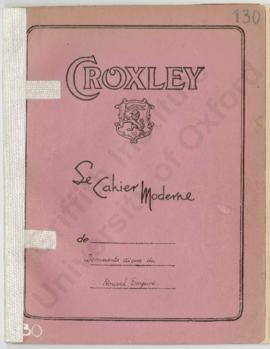
Origin of notebooks - bought in different countries, a substantial number acquired in Egypt and in the UK. Some were re-used school exercise books formerly belonging to Černý's step-daughters, Naomi and Anna Sargant.